What Is an SOP in Software Development (and How Does It Work)?

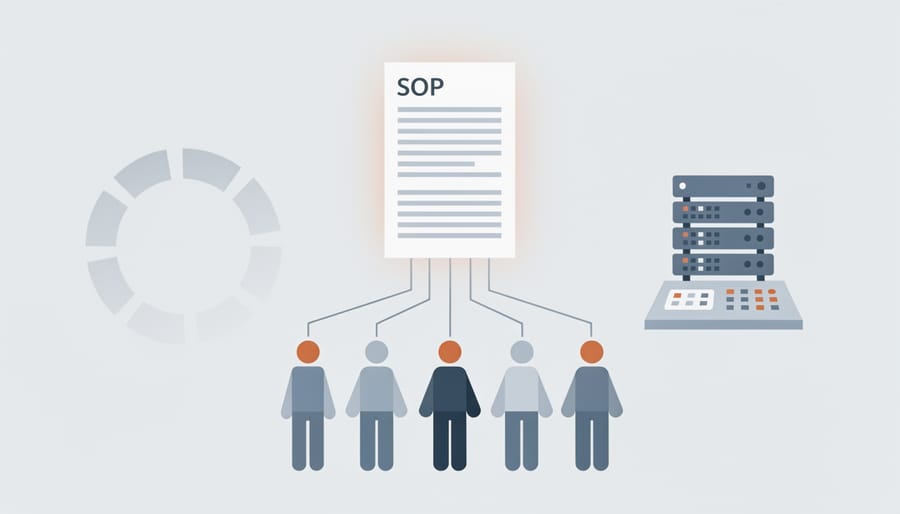
A Standard Operating Procedure (SOP) in software development is a documented, step-by-step guide that defines how development teams execute specific processes, from code reviews and deployment protocols to incident response and quality assurance workflows. Think of it as the playbook that ensures every developer on your team follows the same proven methods, reducing errors and eliminating the guesswork that slows projects down.
For technology decision-makers facing the challenge of scaling development operations while maintaining quality, SOPs transform tribal knowledge into repeatable systems. When your senior developer leaves, your deployment process doesn’t leave with them. When a critical bug surfaces at 2 AM, your team knows exactly which escalation path to follow.
The stakes are higher than simple documentation. Companies with well-implemented SOPs report 30-40% faster onboarding times and significantly fewer production incidents. Yet many organizations struggle with SOPs that sit unused in shared drives, written once and never updated. The difference between effective and ignored SOPs lies in understanding not just what they are, but how they function within modern development workflows.
This article cuts through the theory to explain what makes SOPs work in practice. You’ll learn the core components of development SOPs, the specific types your team needs, and how leading organizations implement them without drowning teams in bureaucracy. The goal is operational excellence that supports your broader technology strategy and strengthens your market position, much like how B2B branding builds consistent value perception across all customer touchpoints.
What an SOP Means in Software Development
A Standard Operating Procedure in software development is a documented, step-by-step set of instructions that defines exactly how a development team should execute a specific technical task or workflow. Think of SOPs as written instructions that transform tribal knowledge into repeatable processes, whether you’re deploying code to production, conducting security reviews, or handling incident escalation. Unlike general documentation that explains “what” a system does or “why” an architecture was chosen, SOPs focus on “how” to perform critical operations consistently across your entire development organization.
- Standard Operating Procedure (SOP)
- A formally documented process that provides explicit, step-by-step instructions for completing a specific technical task or workflow within software development operations. SOPs ensure consistency and compliance regardless of who performs the task.
- Process Documentation
- Broader technical documentation that describes workflows, architectures, and systems. While it includes SOPs, it also encompasses design documents, API specifications, and system diagrams that aren’t necessarily procedural.
- Workflow Standardization
- The practice of creating uniform, repeatable methods for executing development tasks across teams and projects. Standardization reduces variation, accelerates onboarding, and improves quality control.
- Compliance Documentation
- Records and procedures that demonstrate adherence to regulatory requirements, security frameworks, or industry standards. SOPs often serve as compliance documentation by proving established controls exist.
What distinguishes SOPs from other documentation types is their operational focus. Your wiki might explain how your microservices architecture works, but your SOP defines the exact sequence for deploying those services, including rollback triggers, approval gates, and post-deployment verification steps. This precision makes SOPs invaluable for maintaining operational excellence as teams scale, much like how C branding creates consistency across customer touchpoints. When every developer follows the same deployment SOP, you eliminate the variance that causes production incidents and compliance gaps.
How SOPs Work in Development Operations

SOP Creation and Documentation
Creating an effective SOP starts with identifying which processes genuinely need standardization. Look for tasks your team performs repeatedly, deployments, code reviews, incident responses, where inconsistency causes problems or confusion. These are your candidates.
Once you’ve identified a process, involve the people who actually perform it. Developers, DevOps engineers, and team leads bring practical insights that management often misses. Schedule working sessions where these stakeholders walk through the current workflow step-by-step, noting decision points, dependencies, and common pitfalls.
Documentation clarity matters more than comprehensiveness. Write each step in plain language that a new team member could follow. Include the purpose behind each step, not just the action itself, this helps team members understand why they’re doing something, which improves both compliance and adaptation when circumstances change.
Technical accuracy requires review cycles. Draft the SOP, have practitioners test it by following the documented steps, then refine based on their feedback. Version the document from the start using your standard version control system, treating it like code rather than static documentation.
Implementation and Team Adoption
Successfully implementing SOPs requires more than just documentation, teams need structured adoption processes and the right tools to make procedures part of their daily routines.
Training starts with clear communication about why each SOP exists and how it improves team outcomes. Rather than overwhelming developers with comprehensive manuals, effective teams introduce SOPs gradually through hands-on workshops and peer demonstrations. New team members benefit from pairing with experienced colleagues who can model SOP adherence in real scenarios, making abstract procedures concrete and actionable.
Tool integration proves critical for sustainable adoption. Teams embed SOPs directly into their development environments through automated checklists in pull request templates, pre-commit hooks that enforce coding standards, and deployment pipelines that require specific approval steps. This approach removes friction by making compliance the path of least resistance.
Change management requires addressing resistance head-on. When developers view SOPs as bureaucratic obstacles, leaders should involve them in SOP refinement, solicit feedback on practical pain points, and demonstrate how standardization actually reduces cognitive load during high-pressure situations. Teams that treat SOPs as living documents rather than rigid mandates see higher voluntary compliance and fewer workarounds.
Maintenance and Continuous Improvement
SOPs aren’t static documents, they require regular maintenance to remain useful. Most development teams establish quarterly or bi-annual review cycles to assess whether procedures still reflect current practices and tools. When technologies change or workflows evolve, outdated SOPs can create confusion rather than clarity.
Version control systems track SOP updates just like code, maintaining a history of changes and enabling teams to understand why procedures evolved. Assign clear ownership for each SOP, typically to the team lead or subject-matter expert who can identify when updates are needed. Encourage developers to flag SOPs that no longer match reality, treating maintenance as a continuous improvement process rather than a compliance checkbox. The most effective organizations tie SOP reviews to retrospectives or post-mortems, using real incidents to identify documentation gaps and refine procedures based on actual team experience.
Common Types of SOPs in Software Development
Development and Code Management SOPs

Development and code management SOPs establish the ground rules for how teams write, review, and maintain code. Coding standards SOPs define formatting conventions, naming patterns, and architectural principles that keep codebases consistent across developers. They typically include language-specific guidelines and technical debt thresholds.
Version control SOPs outline Git workflows, whether teams use Git Flow, trunk-based development, or another approach, and specify branch naming conventions, commit message formats, and merge protocols. These procedures prevent conflicts and ensure clean repository histories.
Code review SOPs set clear expectations for peer reviews: what reviewers should check, how many approvals are required, turnaround time targets, and when to escalate disagreements. They balance thoroughness with velocity, defining review scope based on change complexity.
Branching strategy SOPs document when to create feature branches, how to handle hotfixes, and release branch protocols. They align development workflows with deployment cadences and help teams coordinate parallel work without stepping on each other’s changes.
Deployment and Release SOPs
Deployment and release SOPs establish controlled, repeatable processes for moving code from development to production. These procedures typically define CI/CD pipeline configurations, including automated testing gates, approval workflows, and environment promotion criteria. A comprehensive deployment SOP specifies which tests must pass before code advances, who can authorize production releases, and what verification steps confirm successful deployment.
Release management SOPs document versioning strategies, release scheduling, and stakeholder communication protocols. They outline how teams coordinate dependencies across microservices and notify relevant parties of upcoming changes.
Rollback protocols form a critical component, detailing exactly when and how teams revert problematic deployments. Effective rollback SOPs include triggers for initiating rollback, step-by-step reversion procedures, and data integrity verification checks. These procedures minimize downtime by eliminating decision paralysis during incidents, teams follow documented steps rather than improvising under pressure.
Security and Compliance SOPs
Security and Compliance SOPs establish protocols for protecting applications and data throughout the development lifecycle. These procedures typically include security code review checklists that developers and security teams follow before merging changes, ensuring vulnerabilities don’t slip into production. Vulnerability management SOPs define how teams scan for, prioritize, and remediate security issues, including timelines for different severity levels and escalation paths when critical threats emerge.
Data handling protocols specify encryption requirements, access controls, and procedures for managing sensitive information like customer data or credentials. These SOPs often align with regulatory frameworks such as GDPR, HIPAA, or SOC 2, detailing how development teams demonstrate compliance through documentation, audit trails, and security testing. Regular compliance audits verify that teams actually follow these procedures, creating accountability and reducing organizational risk.
Incident Response and Support SOPs
Production incidents demand immediate, coordinated responses, which is exactly where incident response SOPs prove their worth. These procedures define how teams detect, triage, communicate, and resolve issues when systems fail or performance degrades.
A typical incident response SOP establishes severity classification (P0 critical outages through P4 minor issues), determines who gets notified at each level, and sets maximum response times. During an active incident, the SOP guides the response: designating an incident commander, establishing a communication channel, documenting actions in real-time, and coordinating handoffs across shifts.
Post-incident, the SOP drives the retrospective process. Teams follow structured templates to analyze root causes, identify preventable factors, and document corrective actions, turning each incident into organizational learning rather than repeated firefighting.
Where SOPs Are Applied in Development Workflows
SOPs in DevOps and CI/CD Environments
DevOps and CI/CD pipelines thrive on repeatable automation, making them ideal environments for SOPs. Organizations typically implement SOPs that define pipeline configurations, approval gates, and rollback procedures to ensure consistent deployments across environments.
Infrastructure-as-code SOPs establish standards for writing, reviewing, and versioning infrastructure definitions. These procedures specify which tools to use (Terraform, CloudFormation, Ansible), mandate peer review of infrastructure changes, and outline testing requirements before applying changes to production systems. Teams document naming conventions, tagging strategies, and state management practices to prevent configuration drift.
Continuous integration SOPs govern build processes, automated testing thresholds, and artifact management. They define when builds trigger, which test suites must pass before merging, and how teams handle failed builds. Deployment SOPs outline environment promotion workflows, specifying who approves production releases, what validation steps occur between staging and production, and how teams execute emergency hotfixes.
These SOPs reduce deployment errors while maintaining the speed DevOps promises. They create guardrails within automation rather than manual bottlenecks, allowing teams to move quickly without sacrificing reliability or security controls.
SOPs for Cybersecurity Operations
SOPs play a critical role in cybersecurity operations, where consistent procedures can mean the difference between containing a threat and experiencing a breach. Security testing SOPs establish repeatable processes for vulnerability assessments, penetration testing schedules, and code security reviews. These procedures ensure that every application undergoes the same rigorous security evaluation before deployment, eliminating gaps that attackers might exploit.
Access management SOPs standardize how teams grant, review, and revoke system permissions. They define approval workflows for privileged access, specify review intervals for user permissions, and document off-boarding procedures. This consistency reduces the risk of orphaned accounts or excessive permissions that create security vulnerabilities.
Threat response SOPs prove invaluable when incidents occur. They outline detection protocols, escalation paths, containment steps, and communication procedures. Teams follow documented playbooks rather than improvising under pressure, which accelerates response times and minimizes damage.
ISTS implemented comprehensive security SOPs for a financial services client facing regulatory compliance requirements. The standardized procedures reduced their security incident response time by 60% and provided auditors with clear documentation of their security practices, streamlining their compliance certification process.
SOPs in Cloud and Managed IT Services
Service providers rely on SOPs to deliver consistent experiences across diverse client environments. Managed IT service teams use documented procedures to standardize cloud provisioning workflows, ensuring each client’s infrastructure follows security best practices and configuration standards regardless of which engineer handles the setup.
SOPs prove especially valuable in multi-tenant cloud environments where providers must maintain strict boundaries between client data while replicating similar service patterns. Procedures covering backup schedules, patch management cycles, and monitoring configurations help teams scale operations without sacrificing quality or introducing security gaps.
For Operations Software Development projects involving cloud migrations or hybrid infrastructure, SOPs document the specific steps for environment replication, credential management, and service handoff, reducing onboarding time for new team members while protecting against configuration drift across client accounts.
Benefits and Challenges of Implementing SOPs
Standard Operating Procedures offer measurable advantages for development organizations. Teams using well-designed SOPs report faster onboarding times, often cutting new developer ramp-up from months to weeks. When processes are documented clearly, junior engineers can follow established patterns without constant oversight, freeing senior staff to focus on architecture and complex problem-solving. SOPs also create consistency across distributed teams, developers in different time zones follow the same deployment checklist, reducing errors and eliminating the “it works on my machine” problem. For compliance-driven industries, SOPs provide auditable evidence that security reviews, data handling protocols, and regulatory requirements are followed systematically, not sporadically.
Quality assurance improves measurably. When code reviews follow a documented process, critical issues get caught before production. Deployment SOPs with built-in verification steps prevent configuration drift and environment mismatches. This standardization supports brand consistency for service providers managing multiple client environments, every client receives the same high-quality delivery regardless of which team handles their project.
The challenges are real, though. SOPs require ongoing maintenance. A deployment procedure written for Docker might become obsolete when the team adopts Kubernetes. If documentation isn’t updated promptly, teams stop trusting it and revert to tribal knowledge. Maintenance overhead increases with the number of SOPs, organizations sometimes create procedures for trivial tasks, adding bureaucracy without value.
Resistance to change represents another hurdle. Experienced developers often view SOPs as constraints on their autonomy, particularly when procedures feel overly prescriptive. The key challenge is calibration: too rigid, and SOPs stifle innovation; too loose, and they fail to provide the consistency that justifies their existence. Finding that balance requires understanding which processes benefit from strict standardization (security protocols, production deployments) versus which need room for engineering judgment (solution architecture, tool selection).
Frequently Asked Questions About SOPs in Software Development
How often should we update our development SOPs?
Review critical SOPs quarterly and update them whenever you adopt new tools, modify workflows, or identify gaps through incident post-mortems. Most organizations schedule formal reviews every six months while allowing teams to flag urgent changes as they occur.
Who should own SOP creation and maintenance?
Assign ownership to the team leads or senior engineers who work within each process daily, not to a centralized documentation team. They understand the nuances and can ensure accuracy, though a technical writer can help with clarity and consistency.
How do we measure whether our SOPs are actually effective?
Track onboarding time for new developers, incident response times, deployment error rates, and audit compliance results. You can also measure adoption directly by monitoring how often teams reference SOP documents and gathering feedback during retrospectives.
What’s the right level of detail for a software development SOP?
Include enough detail that someone unfamiliar with the process can complete it successfully, but avoid step-by-step instructions for basic tasks your team already knows. Focus on decision points, exceptions, and integration with other systems rather than documenting obvious actions.
Should SOPs be mandatory or just guidelines?
Critical processes tied to security, compliance, or production stability should be mandatory with enforcement through code reviews and automated checks. Other SOPs can serve as recommended best practices, allowing teams flexibility while maintaining a baseline standard.
How do we prevent SOPs from becoming outdated quickly?
Build version control and review cycles into your process standardization from the start, assign clear ownership for each document, and integrate SOP updates into your change management workflow so they evolve alongside your technology stack.
Beyond these tactical questions, remember that successful SOP programs balance documentation rigor with team autonomy. Technology leaders often struggle with the perception that SOPs create bureaucracy, but when designed correctly they actually accelerate delivery by eliminating repeated decision-making and reducing tribal knowledge dependencies. The key is treating SOPs as living tools that evolve with your team rather than static documents that constrain innovation.
Well-designed SOPs transform software development from an art into a repeatable science. They enable your teams to scale without sacrificing quality, maintain security standards across distributed environments, and onboard new developers in weeks instead of months. When documentation becomes a strategic asset rather than a bureaucratic burden, your operations software development gains the consistency that enterprise clients demand.
The difference between chaotic growth and controlled scaling often comes down to process standardization. SOPs provide the framework that allows your best practices to survive team changes, technology shifts, and rapid expansion. They’re not constraints on creativity, they’re guardrails that free developers to innovate within proven structures.
At ISTS, we’ve helped technology businesses implement standardized development processes that align with their operational goals. Whether you’re building cloud infrastructure, strengthening cybersecurity protocols, or managing complex IT services, the right SOPs make excellence reproducible. If your organization needs guidance on standardizing development operations, or any aspect of technology implementation, from infrastructure to buying guide resources for strategic decisions, our team brings 30 years of client-focused expertise to help you build processes that work.
Leave a Reply