What Is B2B Branding (and How Does It Work)?

B2B branding is the strategic process of creating and managing a distinct identity for a company that sells products or services to other businesses, encompassing everything from visual design and messaging to company values and customer experience. Unlike consumer brands that often focus on emotional triggers and mass appeal, B2B branding centers on demonstrating expertise, building long-term trust, and communicating tangible business value to professional buyers who make decisions based on ROI, risk mitigation, and operational fit.
For technology decision-makers in 2026, branding has shifted from a nice-to-have marketing exercise to a critical business asset. When your prospects evaluate six to eight vendors before making contact, and procurement committees average seven stakeholders, your brand often makes the shortlist before your sales team even knows a deal exists. A well-executed B2B branding brand cuts through the noise of identical feature claims and establishes the credibility that gets you into the consideration set.
The challenge isn’t just standing out. It’s standing for something that resonates with buyers facing genuine business problems. A logistics software provider might brand around reliability and integration simplicity rather than flashy innovation. A cybersecurity firm competing in a crowded market needs a brand that immediately signals specialized expertise in a specific threat domain or industry vertical.
This article breaks down what B2B branding actually involves, how it functions differently across the buying journey, which components matter most for technology companies, and how to apply branding principles that translate into measurable business outcomes. You’ll see how companies have used strategic branding to command premium pricing, shorten sales cycles, and turn clients into vocal advocates without relying on the tired playbooks of consumer marketing.
Understanding B2B Branding
B2B branding represents how technology companies position themselves in the minds of enterprise buyers, partners, and industry stakeholders. While many organizations reduce branding to logos and colour palettes, effective B2B branding shapes perception across every dimension of market presence, from the clarity of your value proposition to the consistency of client interactions across multi-year relationships.
At its core, B2B branding answers three critical questions for enterprise buyers: what problems you solve, why your approach differs from competitors, and whether your organization can deliver reliably at scale. A cybersecurity firm’s brand, for instance, extends beyond visual identity to encompass technical credibility, incident response reputation, and the expertise demonstrated through threat intelligence publications. These elements build the trust necessary for six-figure contracts and long-term technology partnerships.
The enterprise context fundamentally changes how branding operates. B2C brands often trigger emotional responses and impulse decisions, but B2B technology brands must withstand months of evaluation by procurement teams, technical architects, and C-suite executives. Your brand needs to communicate competence to IT managers while simultaneously conveying strategic vision to business leaders. This dual-audience challenge means effective B2B branding balances technical precision with business outcomes, demonstrating both deep expertise and commercial understanding.
Market positioning forms another essential component. B2B branding defines where you sit in the competitive landscape, whether you lead through innovation, offer mature stability, or specialize in specific industries or use cases. A cloud infrastructure provider positioning as the cutting-edge alternative to established players requires different brand expression than one positioning as the reliable, risk-averse choice for regulated industries. This positioning shapes everything from messaging frameworks to partnership strategies.
Relationship-building separates strong B2B brands from forgettable ones. Enterprise technology decisions rarely end at contract signing. Your brand shapes onboarding experiences, support interactions, quarterly business reviews, and renewal conversations. Companies with cohesive brands ensure every touchpoint reinforces the same commitments, whether a prospect encounters your sales team, reviews technical documentation, or speaks with client success managers three years into a partnership.

How B2B Branding Works
The Strategic Foundation
Building a strong B2B brand starts well before any logo design or messaging framework takes shape. The strategic foundation requires rigorous analysis of the market landscape and a clear-eyed assessment of where your organization can create genuine differentiation.
Market research in B2B contexts goes deeper than demographic data. Technology companies need to understand the operational challenges enterprise clients face, the technical constraints they work within, and the organizational dynamics that influence purchasing decisions. This means conducting stakeholder interviews across client organizations, analyzing industry pain points, and identifying gaps where current solutions fall short. A cybersecurity firm, for example, might discover that compliance complexity matters more to mid-market clients than raw threat detection capabilities.
Competitive analysis must extend beyond feature comparisons. Examine how competitors position themselves, what language they use, and which client segments they prioritize. Look for white space in the market where client needs remain underserved. Study their thought leadership, client testimonials, and case studies to understand the narrative they own. The goal is not imitation but identifying opportunities for authentic differentiation.
The unique value proposition emerges from the intersection of three factors: what enterprise clients genuinely need, what your organization excels at delivering, and what competitors cannot easily replicate. This is not a tagline exercise. A robust value proposition articulates the specific business outcomes you enable, the approach that makes those outcomes possible, and the proof points that demonstrate your capability.
Technology providers often mistake technical superiority for strategic differentiation. The foundation of effective B2B branding rests on understanding that enterprise buyers purchase business transformation, not just technology features.
Implementation Across Touchpoints
B2B technology brands come to life through consistent execution across every point where prospects and clients interact with your organization. Unlike consumer brands that rely heavily on advertising, B2B branding in technology contexts requires coherence across functional touchpoints that directly support the decision-making and client lifecycle.
Your digital presence anchors modern B2B branding. Websites must balance technical credibility with clear value articulation, product pages need specifications and architecture details while maintaining brand voice. LinkedIn profiles, GitHub repositories, and knowledge bases all carry brand identity through consistent visual treatment and messaging approach. Every digital property should reinforce the same positioning and value proposition, whether a prospect lands on your main site or a technical blog post.
Sales and business development materials translate brand strategy into persuasion tools. Proposals, pitch decks, and solution briefs aren’t just documents, they’re brand experiences that demonstrate how you think and solve problems. Visual consistency matters, but substance matters more: your brand promise should be evident in how you frame client challenges and present solutions.
Critical B2B brand touchpoints include:
– Website and product pages balancing technical detail with clear messaging
– Proposals and sales presentations reflecting brand positioning in solution framing
– Case studies demonstrating brand values through real client outcomes
– Support interactions showing brand promise in day-to-day client experience
– Technical documentation maintaining brand voice while serving functional needs
– Events and speaking engagements embodying brand expertise and approach
Client interactions carry significant brand weight in B2B contexts. How your solutions architects explain technical approaches, how support teams resolve issues, how account managers conduct business reviews, all shape brand perception more powerfully than marketing materials. Implementation teams and technical staff become brand ambassadors whether they recognize it or not.
Technical content builds brand equity through demonstrated expertise. White papers, API documentation, integration guides, and troubleshooting resources that help clients succeed reinforce your brand’s competence and reliability more effectively than promotional copy.
The Decision-Making Journey
Enterprise technology purchases rarely involve a single decision-maker. A typical B2B buying committee includes technical evaluators, financial gatekeepers, operational stakeholders, and executive sponsors, each bringing different priorities and concerns. Effective B2B branding addresses this complexity by creating touchpoints that resonate across these diverse roles simultaneously.
Strong branding reduces perceived risk throughout the evaluation process. When procurement teams encounter a recognizable brand with consistent messaging about security, reliability, and proven implementation success, they move faster through approval stages. The brand becomes a shorthand for due diligence already completed: “We know this company delivers.”
Branding also facilitates internal advocacy. Technical champions need ammunition to sell solutions upward to CFOs and C-suite executives who won’t review product specifications. A brand that clearly communicates business outcomes, not just features, gives these internal advocates language and credibility to build consensus. When your brand consistently emphasizes measurable ROI, risk mitigation, or competitive advantage, champions can confidently present your solution to skeptical stakeholders.
The decision journey extends well beyond contract signing. Post-purchase, branding continues influencing how clients perceive implementation challenges, adopt new features, and justify renewals. Organizations that maintain brand consistency through onboarding, support interactions, and ongoing communications reinforce the original purchase decision, making renewal conversations substantially easier and positioning themselves for account expansion when new needs emerge.
Types and Components of B2B Branding
Core Brand Components
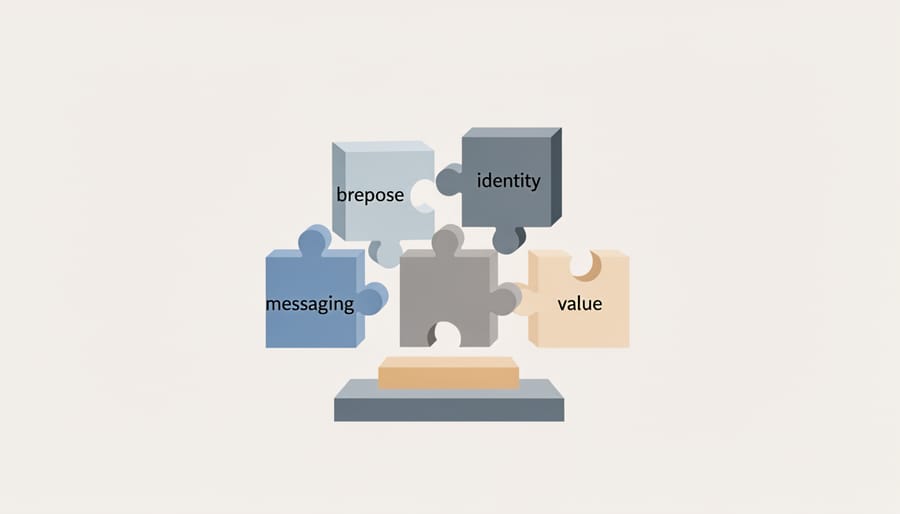
Every B2B technology brand rests on four foundational components that work together to create consistent market presence and drive business outcomes. These elements form the structural backbone of brand strategy, not cosmetic choices, but strategic frameworks that guide every client interaction.
Visual Identity System comes first, but extends far beyond a logo. Your visual identity encompasses typography, colour palette, imagery style, and design principles that appear across everything from technical documentation to conference presentations. For technology companies, this system must convey both innovation and reliability, a balance that sets enterprise brands apart from consumer-focused competitors.
Messaging Framework defines what you say and how you say it across different contexts. This framework includes positioning statements for various solutions, audience-specific value propositions, and core messages that address enterprise pain points. Technology buyers evaluate multiple vendors simultaneously; a clear messaging framework ensures your differentiation comes through consistently whether prospects encounter your brand through a whitepaper, demo, or sales conversation.
- Brand Architecture
- The organizational structure defining relationships between parent company, sub-brands, products, and services. Determines whether you use a monolithic (single brand), endorsed (parent validates sub-brands), or house of brands approach.
- Messaging Hierarchy
- Structured framework organizing messages by priority and audience, from overarching value proposition down through solution-level positioning and feature-specific claims. Ensures consistent prioritization across all communications.
- Visual Identity System
- Comprehensive design standards governing logo usage, typography, colour application, imagery, and layout principles across all brand touchpoints. Maintains visual consistency that builds recognition and credibility.
- Brand Guidelines
- Documentation codifying standards for visual identity, messaging, voice, and brand application across contexts. Enables teams and partners to execute brand consistently without constant oversight.
Brand Voice establishes personality and tone that humanizes technical offerings. Your voice should reflect expertise without alienating non-technical stakeholders in the buying process, remembering that enterprise decisions involve procurement, finance, and business leaders alongside IT professionals. A well-defined voice adapts to context (formal for RFP responses, conversational for thought leadership) while maintaining recognizable character.
Value Proposition Architecture connects features to business outcomes. Technology buyers don’t purchase capabilities, they purchase solutions to problems and paths to strategic goals. Your architecture maps technical offerings to client challenges, competitive advantages, and measurable business impact, providing the strategic narrative that justifies enterprise investment.
B2B Branding Approaches
B2B technology companies can pursue several distinct strategic approaches to branding, each emphasizing different aspects of their market position and value delivery. The most effective choice depends on your competitive environment, organizational strengths, and target audience priorities.
Thought leadership branding positions your company as an authoritative voice shaping industry conversations. Rather than leading with product features, you build credibility through original research, frameworks, and insights that help buyers think differently about their challenges. This approach works particularly well for consulting firms, enterprise software platforms, and established technology providers addressing complex or emerging problems. A cybersecurity company might publish quarterly threat intelligence reports that CISOs reference in board meetings, making the brand synonymous with expert guidance before any sales conversation begins.
Solution-focused branding centers on specific problems your technology solves and measurable outcomes you deliver. This approach translates your offerings into clear business value, emphasizing results over methodology or company history. It suits organizations with demonstrable ROI, especially in competitive categories where buyers evaluate multiple vendors against concrete criteria. A managed services provider might brand around “guaranteed 99.99% uptime” or “reducing IT operational costs by 30%”, making the value proposition immediately tangible to procurement teams evaluating bids.
Relationship-based branding emphasizes partnership, long-term collaboration, and deep understanding of client contexts over transactional service delivery. You position your brand around trust, responsiveness, and client success rather than technological superiority alone. This strategy fits companies serving clients through ongoing engagements, systems integrators, technology consultancies, and custom software development firms where relationships determine renewal and expansion. Your brand promise centers on being a reliable extension of client teams rather than just a vendor.
Innovation-led branding highlights cutting-edge capabilities, technical excellence, and pioneering approaches to established problems. You attract early adopters and forward-thinking organizations by emphasizing what’s new and differentiated about your technology. This works for startups disrupting legacy markets, R&D-focused companies, and organizations competing on technical sophistication rather than market share. An AI infrastructure provider might brand around breakthrough performance benchmarks or novel architectures that redefine what’s technically possible.
Most successful B2B technology brands combine elements from multiple approaches but lead with one primary strategy that drives all brand decisions.
Uses and Applications of B2B Branding

Building Market Differentiation
In crowded technology markets where products often share similar feature sets, B2B branding becomes the mechanism that elevates one provider above functionally equivalent competitors. A cybersecurity firm selling endpoint protection faces dozens of alternatives with comparable detection rates and compliance certifications. What separates the winner is how its brand communicates unique value, whether that’s unmatched implementation speed, vertical-specific expertise, or a customer success philosophy that resonates with enterprise buyers.
Effective differentiation through branding requires identifying what genuinely sets your company apart and amplifying that distinction across every market touchpoint. A cloud infrastructure provider might own “multi-cloud orchestration without vendor lock-in” as its positioning cornerstone, then reinforce this through case studies, technical content, and sales conversations that consistently demonstrate this capability. The brand becomes shorthand for this specific value in prospects’ minds.
The positioning clarity this creates proves particularly valuable when technology buyers evaluate long lists of potential vendors. Strong B2B branding acts as a filter, helping the right prospects self-select into your sales process while deterring poor-fit opportunities. A software development firm branded around regulated industry expertise naturally attracts healthcare and financial services clients while efficiently screening out retail prospects better served elsewhere.
Market differentiation through branding extends beyond initial awareness. It shapes how analysts categorize your company, which partnerships make strategic sense, and how existing clients describe you to peers. When your brand clearly owns a defensible market position, that clarity compounds across every business development activity.
Enabling Sales and Business Development
A well-developed B2B brand functions as a silent sales enabler throughout the deal cycle. When prospects already recognize your brand and understand what you stand for, initial conversations skip past basic credibility establishment and move directly to solution fit. Technology buyers researching enterprise software, for instance, gravitate toward brands they’ve encountered through thought leadership content or industry presence, cutting weeks from early-stage qualification.
Account-based marketing campaigns gain significant traction when built on strong brand foundations. Your brand becomes the consistent thread connecting targeted content, personalized outreach, and multi-touch engagement across decision-maker committees. Instead of starting from zero with each stakeholder, your brand equity transfers across the buying group, creating compound recognition effects that generic approaches cannot replicate.
In enterprise deal-making, brand strength directly influences procurement outcomes. When technical evaluations produce similar scores across vendors, brand reputation often tips final decisions. Procurement teams justify larger investments more easily when selecting recognized brands, while risk-averse IT leaders find board approval smoother with established names. Your brand essentially de-risks the purchase decision, providing psychological reassurance that accompanies technical validation, a critical advantage when contracts involve six or seven figures and multi-year commitments.

Supporting Client Retention and Expansion
Strong B2B branding extends far beyond customer acquisition. In enterprise technology contexts, where client relationships often span years and contracts represent significant revenue, branding plays a critical role in retention and account growth.
A consistent brand experience builds trust over time. When clients encounter the same professionalism, responsiveness, and technical excellence across support interactions, project deliveries, and service touchpoints, they develop confidence in the ongoing relationship. This consistency reassures stakeholders during contract renewals and reduces the appeal of competitive alternatives.
Brand recognition also facilitates expansion within existing accounts. Clients familiar with your brand are more receptive to exploring additional services or solutions. A cybersecurity firm known for network protection can more easily introduce cloud security offerings to established clients because the brand carries proven credibility.
The post-sale brand experience matters enormously. Technical documentation quality, customer success interactions, and even how your team handles service issues all reinforce or undermine brand promises. Technology companies that align their operational delivery with brand positioning see measurably higher Net Promoter Scores and account expansion rates.
Your brand becomes shorthand for the relationship itself, representing accumulated positive experiences that make clients advocates rather than just customers.
B2B Branding Best Practices for Technology Companies
Technology companies building or refining their B2B brand should start by anchoring every branding decision in genuine technical expertise and proven client outcomes. Your brand promise must reflect what your organization actually delivers, not aspirational positioning disconnected from operational reality. If you claim innovation leadership, your product roadmap and engineering practices need to demonstrate it. If you emphasize reliability, your uptime metrics and support response times should validate that commitment.
Develop a clear, consistent messaging framework that resonates across all stakeholder levels within client organizations. Enterprise technology purchases involve multiple decision-makers, from C-suite executives focused on business outcomes to technical architects evaluating implementation details. Your brand messaging should translate seamlessly between these audiences without contradicting itself. The CFO needs to understand ROI and risk mitigation, while the infrastructure team wants architectural specifics. Create tiered messaging that maintains brand consistency while addressing each stakeholder’s concerns.
Invest in thought leadership that demonstrates deep domain expertise rather than superficial trend-chasing. Publish technical whitepapers that solve real problems your prospects face. Share case studies with specific metrics and implementation details, not vague success stories. Contribute meaningfully to industry conversations through original research, conference presentations, and substantive content that advances understanding. Thought leadership builds brand authority when it reflects genuine expertise, not when it repackages generic advice.
Ensure brand consistency across every client touchpoint, particularly technical documentation and support interactions. Your sales materials might promise exceptional service, but if your support team’s email templates feel disconnected or your technical documentation lacks the clarity your brand emphasizes, you create credibility gaps. Review client-facing materials from first contact through post-sale support to identify where brand experience breaks down. Train technical staff on brand voice, not to make engineers sound like marketers, but to ensure communications reflect brand values like clarity, responsiveness, or innovation.
Measure brand performance using metrics that matter in B2B contexts. Track brand awareness within your target market segments through regular surveys of decision-makers. Monitor how brand strength influences sales cycle length by comparing known versus unknown prospects. Measure unaided recall among relevant audiences and track changes in brand associations over time. Client retention rates and expansion revenue from existing accounts also reflect brand strength, satisfied clients who trust your brand buy more and stay longer.
Finally, maintain patience with brand development timelines. B2B branding in technology operates on longer cycles than consumer branding. Enterprise buyers research carefully and take time building trust. Consistent execution over quarters and years matters more than campaign-level creativity. Resist the temptation to rebrand frequently or chase short-term visibility at the expense of strategic positioning.
Common B2B Branding Challenges and Solutions
Technology companies encounter recurring obstacles when building and maintaining B2B brands, often stemming from the technical nature of their offerings and the complexity of enterprise sales environments.
Inconsistency Across Teams and Touchpoints
The most common challenge surfaces when different departments present conflicting brand messages. Sales teams might emphasize speed and flexibility while technical teams stress security and compliance, creating confusion for prospects evaluating solutions. Engineering documentation uses one terminology set, marketing materials another, and customer success teams adopt informal language that doesn’t match either.
Address this by creating a living brand guidebook that technical teams actually use, not a 100-page PDF that sits unread. Include code commenting standards, API documentation style guides, and approved technical terminology alongside visual identity rules. Schedule quarterly cross-functional brand reviews where sales, engineering, and marketing align on messaging for new products before launch. Appoint brand champions in each department who can answer questions and spot inconsistencies before they reach clients.
Balancing Innovation with Reliability
Technology companies face tension between positioning as cutting-edge innovators and demonstrating the stability enterprise clients demand. Too much innovation messaging makes IT decision-makers nervous about untested solutions. Too much emphasis on reliability makes you sound outdated in fast-moving sectors like AI or cloud infrastructure.
The solution lies in strategic messaging layers. Lead with innovation when addressing individual contributors and technical evaluators who want sophisticated capabilities. Shift to proven reliability and risk mitigation when C-suite executives and procurement teams enter the conversation. Show innovation through case studies of successful implementations rather than abstract technological possibilities. One cybersecurity firm resolved this by branding their approach as “battle-tested innovation,” highlighting years of deployment experience alongside their advanced threat detection capabilities.
Measuring Brand Impact and ROI
Executives struggle to justify branding investments when sales cycles span months and attribution gets murky. Unlike B2C brands tracking immediate conversion, B2B branding influences deals that involve multiple touchpoints over extended periods.
Establish proxy metrics that demonstrate brand health: track consideration set inclusion through win-loss interviews, measure brand recall among target accounts through quarterly surveys, and monitor deal velocity comparing branded versus unbranded opportunities. Calculate customer acquisition cost differences between prospects who engaged with brand content early versus those entering late in the funnel. One software provider found that deals where prospects attended their thought leadership events closed 40% faster, providing clear ROI evidence for continued brand investment.
Frequently Asked Questions
How long does it take to see results from B2B branding efforts?
B2B branding is a long-term investment with different metrics showing results at different stages. You’ll typically see initial awareness metrics improve within 3-6 months, while meaningful impact on sales cycles and win rates often takes 12-18 months as the brand becomes established in your target market.
What should we budget for B2B branding?
Technology companies typically allocate 5-10% of revenue to overall marketing, with 20-30% of that dedicated to branding initiatives during active brand-building phases. For a complete rebrand, expect investment in the $50,000-$250,000 range depending on company size and scope, while ongoing brand management requires consistent investment in content, design, and brand experience.
How is B2B branding different from B2B marketing?
B2B branding defines who you are as a company, your identity, values, and market position, while marketing promotes what you offer and drives specific business outcomes. Branding is the foundation that makes your marketing more effective by establishing credibility and recognition before prospects engage with your campaigns.
How do we measure B2B branding success?
Track both leading indicators like brand awareness, website traffic, and search visibility, and lagging indicators including sales cycle length, win rates, client retention, and revenue from existing accounts. Qualitative feedback from sales teams and clients about brand perception provides equally valuable insight into whether your branding resonates with decision-makers.
These questions reflect the real concerns technology leaders face when considering branding investments. The timeline question matters because CFOs want to understand the return horizon before committing resources. Budget questions arise because branding feels less concrete than demand generation, making it harder to justify internally without benchmarks.
The distinction between branding and marketing often confuses teams who see them as interchangeable, when they’re actually complementary disciplines with different purposes. Strong branding amplifies marketing effectiveness, but marketing tactics alone won’t build lasting brand equity. Understanding this relationship helps technology companies allocate resources appropriately rather than expecting brand campaigns to generate immediate pipeline.
Measurement challenges stem from branding’s indirect impact on revenue. While a lead generation campaign shows clear ROI through opportunity creation, branding influences every touchpoint without always being the last touch before conversion. Combining quantitative metrics with qualitative signals gives a complete picture of brand health and helps justify continued investment even when results aren’t immediately visible in pipeline reports.
Leave a Reply