How to Choose a Website Partner That Fits Your IT Setup: A Buying Guide for Small Businesses

Choosing the right website partner for your small business means finding a developer or agency that understands your existing IT infrastructure, speaks the same technical language as your team, and can deliver a solution that won’t create headaches down the road. The decision rests on three critical pillars: technical compatibility with your current systems, alignment between their service model and your operational needs, and their ability to scale alongside your business growth.
Most small business owners approach this decision backward. They fall in love with a portfolio, negotiate a price, and only discover compatibility issues after contracts are signed and development begins. The result? Websites that can’t integrate with existing CRM systems, hosting environments that conflict with security policies, or partnerships that dissolve when technical debt becomes unmanageable.
Key Takeaway: Successful website partnerships hinge on three pillars: technical compatibility with your current infrastructure, service delivery models that match your operational rhythm, and proven scalability as your business evolves. Evaluate these dimensions before portfolio or price.
The stakes are higher in 2026 than ever before. Your website isn’t just a digital brochure anymore. It’s the hub connecting your point-of-sale system, customer relationship management platform, email marketing tools, and often your inventory management. A mismatched partner creates integration bottlenecks that cost far more than the initial development budget.
Technical decision-makers who get this right share a common approach. They audit their current IT setup first, document their integration requirements second, and only then begin evaluating potential partners against specific technical criteria. This framework has helped businesses avoid the common trap of selecting partners based on creative appeal while ignoring the infrastructure realities that determine long-term success. Whether you’re working with A Creative Agency or any other development partner, the evaluation methodology remains constant across different business sizes and technical environments.
Why IT Compatibility Matters When Selecting a Website Partner
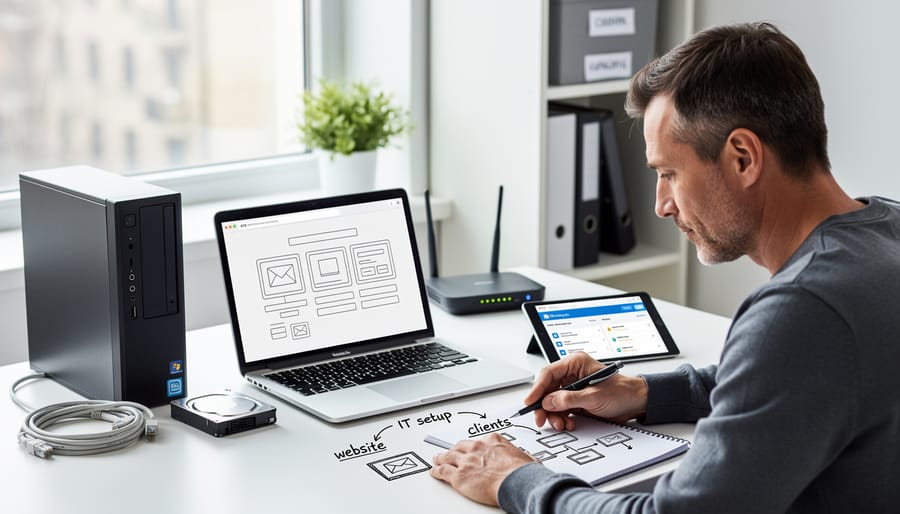
Choosing a website partner without considering your existing IT infrastructure is like hiring a contractor to build an extension without checking if the foundation can support it. The consequences compound quickly.
Integration headaches top the list of problems. When your website runs on incompatible systems, connecting it to your CRM, email marketing tools, payment processors, or inventory management becomes a custom coding project for each connection. One manufacturing client came to us after their previous provider built a beautiful site on a platform that couldn’t communicate with their ERP system. Every product update required manual data entry in two places, costing them 15 hours per week and creating frequent pricing errors that damaged customer relationships.
Security vulnerabilities multiply when systems don’t align. A website partner unfamiliar with your network architecture might introduce weak authentication protocols, expose database ports, or implement plugins that conflict with your firewall rules. These gaps create entry points for attackers. Proper IT alignment means your website adheres to OWASP best practices for security and integrates with your existing security monitoring, backup systems, and incident response protocols rather than operating as an isolated risk.
Operational inefficiencies drain resources. Mismatched technology stacks mean your IT team struggles to troubleshoot issues, updates break unexpectedly, and simple changes require outsourcing to specialists who understand the foreign system. Server environments that don’t match your hosting standards create performance bottlenecks. Email systems that can’t authenticate properly land in spam folders.
A regional healthcare provider approached us after abandoning a website that their managed service provider couldn’t support. The previous developer used a tech stack completely foreign to their IT team. When the site went down, no one could fix it. We rebuilt their presence using infrastructure compatible with their existing Microsoft environment and backup protocols. Their IT director now manages routine updates internally, response times dropped from days to hours, and they integrated patient portals directly with their practice management software.
The right technical fit transforms your website from a standalone liability into an integrated business asset.
Essential Factors for Choosing a Website Partner
Technical Infrastructure Compatibility
Your website partner’s technical infrastructure must align with the systems you already use and the direction your business is heading. Start by identifying your current hosting model, whether you rely on cloud services like AWS or Azure, on-premise servers, or a hybrid approach, then confirm your prospective partner supports that environment or can facilitate a smooth transition. Server technologies matter significantly: if your internal team uses specific programming languages (PHP, Python.NET) or relies on particular database systems (MySQL, PostgreSQL, Microsoft SQL), the partner’s tech stack should integrate seamlessly rather than force you into costly migrations or ongoing compatibility workarounds.
Evaluate these critical compatibility checkpoints:
- Cloud versus on-premise hosting capabilities and migration support
- Programming languages and frameworks used for development
- Content management system platforms and version support
- Database technologies and data structure requirements
- API protocols and integration standards (REST, GraphQL, webhooks)
- Authentication systems and single sign-on compatibility
API capabilities determine how well your website connects with existing operations software CRM systems, and other business tools. Ask detailed questions about the partner’s API documentation, rate limits, and real-world integration examples. Request specific information about how they handle data synchronization between systems and whether they support the authentication protocols your security framework requires. A technically compatible partner should speak your IT team’s language and demonstrate clear understanding of your infrastructure constraints without requiring extensive translation or workarounds.
Security and Compliance Standards

Your website partner’s security measures directly affect your business’s risk exposure. A data breach or compliance failure can cost thousands in fines, lost customer trust, and remediation expenses that dwarf your initial website investment.
Start with the fundamentals: every website partner must provide SSL certificates as standard, encrypting data between your site and visitors. Look for partners who implement multi-factor authentication for administrative access and maintain regular automated backups stored in geographically separate locations. These aren’t premium features, they’re baseline requirements.
For payment processing, PCI-DSS compliance becomes mandatory if you handle credit card transactions directly. Even if you use third-party payment gateways, verify your partner follows PCI standards to protect cardholder data that touches your infrastructure. If you serve European customers or handle their information, GDPR compliance dictates how personal data must be collected, stored, and managed.
Ask potential partners how their security framework integrates with your existing IT policies. Do they conduct regular vulnerability assessments? Can they provide penetration testing reports? How do their protocols align with your current ransomware defense strategy and disaster recovery plans?
For online retail businesses, specialized security for e-commerce platforms becomes critical, particularly protecting customer payment information and transaction data.
Request documentation of their security certifications, incident response procedures, and uptime guarantees. A qualified partner will readily share their security audit results and compliance certificates without hesitation.
Scalability and Growth Support

Your website partner should demonstrate clear pathways for growth that don’t require starting over from scratch. Ask about bandwidth limits and what happens when you exceed them, sudden traffic spikes from a successful campaign shouldn’t crash your site or trigger penalty fees. Look for partners who offer tiered service levels you can move between without migrating your entire site.
Feature expansion matters more than initial capabilities. Can they add e-commerce functionality when you’re ready to sell online? What about customer portals, appointment booking, or integrations with CRM systems as your operations become more sophisticated? Partners with modular architecture let you bolt on new capabilities without rebuilding your foundation.
Performance optimization should scale with your needs. A site that loads quickly with 100 monthly visitors needs different infrastructure at 10,000 visitors. Verify whether your partner monitors performance metrics and proactively suggests upgrades, or if you’ll need to diagnose slowdowns yourself.
Resource allocation transparency prevents nasty surprises. Understand whether you share server resources with other clients, and how storage, processing power, and database capacity expand. Defined upgrade pathways with predictable costs let you budget for growth rather than scrambling when you outgrow your current plan.
Support and Managed IT Services

A website partner’s support structure determines whether your IT operations run smoothly or suffer costly downtime. Start by examining the service level agreement (SLA) to understand guaranteed uptime percentages, response times for different issue severities, and the penalties or credits if they fail to meet commitments. Look for at least 99.5% uptime guarantees and response times under one hour for critical issues. Consider whether their support hours match your business needs, 24/7 availability matters if you serve customers across time zones or operate outside standard business hours.
Evaluate how their technical support team handles issues. Ask about their escalation procedures, average resolution times, and whether you’ll have a dedicated account manager who understands your IT environment. Request references from similar-sized businesses and inquire about their experience with support quality during actual emergencies.
The website partner’s support should complement your existing IT resources. If you already have managed IT services verify that the website provider can coordinate with your MSP on security patches, software updates, and troubleshooting. Check whether they provide proactive monitoring, automated backups, and regular maintenance windows that align with your operational schedule. Some providers offer tiered support packages, choose one that fills gaps in your current IT capabilities without creating redundant costs or conflicting responsibilities between teams.
Budget and Total Cost of Ownership
Understanding the true financial commitment extends well beyond the initial price quote. When evaluating website partners, small businesses must analyze pricing models to identify the most sustainable long-term investment for their IT budget.
Most website providers use one of three pricing structures: fixed-fee projects with defined deliverables, monthly subscription models with tiered service levels, or hourly billing for custom development work. Fixed-fee arrangements offer predictable budgeting but may limit flexibility for scope changes. Subscription models provide ongoing support and updates but create perpetual operating expenses. Hourly billing gives maximum flexibility yet introduces cost uncertainty that can strain small business budgets.
Beyond setup costs, factor in the ongoing expenses that constitute total cost of ownership: monthly hosting fees, SSL certificate renewals, software license fees, security patches, content updates, backup storage, bandwidth overages, and technical support hours. These recurring costs typically represent 15-25% of the initial development investment annually.
Consider migration costs if the partnership doesn’t work out. Extracting your data, rebuilding integrations with your existing IT systems, and retraining staff can cost 30-50% of the original implementation budget. Partners who use proprietary platforms or custom code create higher switching costs than those building on open standards and portable architectures.
Request detailed quotes that separate initial setup from ongoing operational costs, and ask providers to project three-year total ownership scenarios. This transparency reveals which partners offer genuine value versus those with attractive entry prices that balloon over time.
Types of Website Partners and Which Fits Your IT Setup
Full-Service Technology Solutions Providers
Full-service technology solutions providers deliver end-to-end IT services under one roof, combining website development, hosting infrastructure, cybersecurity protection, and ongoing technical support. These comprehensive partners handle everything from initial custom software development through long-term system maintenance, creating a unified technology environment rather than forcing you to coordinate multiple vendors.
This model works best for small businesses lacking dedicated IT staff or those wanting to consolidate fragmented technology relationships. When your accountant, project management tools, and customer database need to connect with your website, a full-service provider can architect the entire ecosystem for seamless data flow. They own the integration points, eliminating the finger-pointing that happens when your hosting company blames your developer and vice versa.
The trade-off is commitment and cost. You’re investing in a partnership, not just purchasing a service. Expect higher monthly fees than standalone hosting, but you gain predictable budgets, proactive system monitoring, and a team that understands your complete IT landscape. This becomes valuable when security patches affect both your website and internal systems simultaneously, your provider coordinates the updates rather than leaving you to manage competing priorities across separate vendors.
Specialized Web Development Agencies
Specialized web development agencies excel at building custom digital solutions tailored to specific business requirements. Unlike full-service providers, these firms concentrate their expertise on software engineering, application architecture, and complex web functionality rather than bundled IT services. This focus makes them particularly valuable when your small business already has reliable hosting infrastructure and internal IT support but needs sophisticated web capabilities beyond template-based platforms.
These agencies typically maintain smaller, highly skilled development teams with deep expertise in modern frameworks, APIs, and integration patterns. They’re the right choice when you need custom CRM connections, proprietary inventory systems linked to your website, or specialized workflows that off-the-shelf solutions can’t deliver. Their developers understand how to build responsive website design that connects seamlessly with existing databases, authentication systems, and business logic already running in your IT environment.
The trade-off is clear: you’ll get exceptional technical craftsmanship and custom functionality, but you’ll remain responsible for coordinating hosting, security patching, and ongoing infrastructure management either internally or through your existing managed service provider.
Managed Hosting and Domain Providers
Managed hosting providers deliver the server infrastructure, uptime guarantees, and technical foundation your website runs on without the overhead of custom development services. These companies, ranging from enterprise-grade providers like Rackspace and Liquid Web to specialized WordPress hosts such as WP Engine, focus exclusively on keeping your site fast, secure, and available.
This model works best when you already have developers on staff or work with a separate agency for design and functionality. You’re essentially renting robust, professionally-maintained server space with automated backups, SSL certificates, DDoS protection, and performance monitoring built in. Your IT team retains control over the application layer while offloading infrastructure management.
The technical compatibility check here centers on server specifications: Does the host support your required PHP version, database type, and any frameworks your developers use? Can you easily configure DNS records, manage subdomains, and integrate with your existing email systems? Most managed hosts offer staging environments and git integration, making deployment workflows straightforward for technical teams.
Cost structures are typically subscription-based, scaling with traffic, storage, and feature requirements. Expect clearer pricing than full-service providers but less hand-holding, you’re paying for infrastructure excellence, not strategic guidance or design work.
Cloud-Based Platform Providers
Cloud-based platform providers deliver website solutions through software-as-a-service (SaaS) or platform-as-a-service (PaaS) models, where the vendor manages infrastructure, security updates, and core technical operations. These providers offer pre-built website builders, content management systems, and e-commerce platforms accessible through web browsers without requiring local server installations.
This model suits small businesses with minimal internal IT staffing or technical expertise. You get predictable monthly pricing that covers hosting, maintenance, security patches, and automatic backups. The vendor handles system administration tasks that would otherwise require dedicated IT personnel.
Cloud platforms typically include templates, drag-and-drop editors, and integrated tools for SEO, analytics, and customer relationship management. Major providers operate multi-tenant environments with shared infrastructure, which keeps costs low while offering professional features. Your data lives in vendor-managed data centers with redundancy and disaster recovery built in.
The trade-off involves reduced customization flexibility and vendor lock-in. Most cloud platforms use proprietary architectures that make migration difficult. Integration capabilities vary widely, some offer robust APIs connecting to accounting software, CRM systems, and inventory management, while others restrict third-party connections. Businesses planning significant custom development or requiring specialized integrations should verify API documentation and available plugins before committing.
How to Evaluate a Website Partner’s Technical Capabilities
Evaluating a website partner’s technical capabilities requires more than reviewing a polished sales pitch. You need concrete evidence that they can deliver on your specific IT requirements and integrate smoothly with your existing infrastructure.
Start by examining their portfolio with a critical eye toward technical complexity, not just visual design. Look for projects similar in scope and technical requirements to yours. A partner who built attractive brochure websites may lack the expertise for custom database integration or complex API connections. Request detailed case studies that explain the technical challenges faced, solutions implemented, and measurable outcomes achieved. Pay attention to whether they discuss specific technologies, frameworks, and integration methodologies rather than vague descriptions of success.
Request references from clients with similar IT setups to yours. When speaking with references, ask about technical issues that arose during the project, how quickly problems were resolved, and whether the partner demonstrated genuine expertise or relied on trial and error. Technical competence shows itself most clearly when things go wrong.
During initial consultations, ask probing questions that reveal the depth of their technical knowledge and their approach to IT compatibility:
- What specific technologies and frameworks do you work with, and why do you recommend them for our business?
- How do you assess compatibility between our existing IT infrastructure and the solutions you propose?
- Can you describe your experience integrating websites with systems like ours (CRM, ERP, legacy databases)?
- What security protocols and compliance standards do you implement by default?
- How do you handle data migration from our current systems without disruption?
- What testing procedures do you follow before deployment, particularly for integration points?
- Can you provide documentation of your technical standards and development processes?
Listen carefully to their responses. Technical experts explain concepts clearly without hiding behind jargon, acknowledge potential challenges honestly, and ask informed questions about your environment before promising solutions. If they claim everything is simple or guarantee compatibility without understanding your systems first, that’s a red flag indicating insufficient technical rigor.
Common Mistakes Small Businesses Make When Choosing a Website Partner
Small businesses often stumble into expensive, time-consuming traps when selecting a website partner, usually because they rush the decision or overlook how their choice affects their existing technology. Recognizing these mistakes upfront can save you from costly do-overs and wasted months.
Ignoring IT Infrastructure Compatibility
The most damaging mistake is treating your website as an isolated project rather than part of your technology ecosystem. Many businesses choose a partner who builds an impressive-looking site that won’t integrate with their CRM, accounting software, or internal databases. The consequence? You end up with disconnected systems, manual data entry, and frustrated employees trying to maintain duplicate records across platforms. Before signing anything, verify that your prospective partner understands your current tech stack and has successfully integrated with similar systems before.
Focusing Exclusively on Price
Choosing the cheapest bid might seem prudent, but rock-bottom pricing usually signals corners cut somewhere, whether in security implementation, code quality, or post-launch support. A $2,000 website that crashes under moderate traffic or gets hacked within six months costs far more than a $8,000 solution built properly from the start. Evaluate total cost of ownership over three years, not just the initial invoice.
Neglecting Security and Compliance Requirements
Small businesses frequently assume basic security comes standard, then discover their partner skipped SSL implementation, uses outdated server software, or has no disaster recovery plan. If you handle customer data, accept payments, or operate in a regulated industry, you need documented security protocols and compliance certifications upfront. Ask specific questions about encryption, backup frequency, and how they handle security patches.
Underestimating Future Scalability Needs
Building for today’s 50 monthly visitors without planning for 5,000 next year creates expensive rebuilds. Partners who lock you into rigid platforms or proprietary systems make growth painful. Choose solutions with clear upgrade paths, even if you don’t need that capacity immediately. A site that handles 10x your current traffic gives you room to succeed.
Failing to Verify Technical Expertise
Accepting a partner’s claims without evidence leads to disappointment. Request specific case studies matching your industry and technical requirements, check client references directly, and ask detailed questions about their development process. A qualified partner welcomes technical scrutiny and provides concrete examples of solving challenges similar to yours.

Making Your Final Decision: A Practical Framework
Once you’ve narrowed your options to two or three finalists, create a weighted scoring matrix. List your critical requirements, technical compatibility, security standards, scalability, support quality, and budget, then assign each category a weight based on your priorities. Score each partner on a scale of 1-10 for every criterion. A growing accounting firm we worked with used this approach and discovered their lowest-priced option scored poorly on technical integration, while a mid-tier provider excelled in areas that mattered most to their operations.
Before committing, conduct thorough reference checks. Ask each partner for three current clients with similar IT setups to yours. Contact these references directly and ask specific questions: How responsive is support when issues arise? Did the initial project stay on budget and schedule? How well did the website integrate with existing systems? Were there unexpected costs? References often reveal issues that won’t surface during sales presentations.
Request a pilot project or proof-of-concept for complex integrations. A limited-scope test, perhaps building a single feature or conducting a technical integration assessment, demonstrates the partner’s capabilities and working style without full commitment. This approach works particularly well if you’re uncertain about API compatibility or data migration challenges.
Review contracts carefully with your legal and IT teams. Verify ownership rights for all code and content, confirm service level agreements include specific response times and uptime guarantees, and clarify the exit strategy if you need to migrate later. Look for clear terms around scope changes, additional fees, and intellectual property.
Consider how the partner approaches online marketing integration, since your website will likely connect to analytics platforms, email systems, and advertising tools. A manufacturing client chose their partner partly because of demonstrated expertise in connecting web infrastructure to their marketing automation platform, which streamlined their entire digital ecosystem.
Schedule final presentations where shortlisted partners walk through their proposed solution, timeline, and support structure. The quality of these presentations often reveals organizational competence and communication style you’ll experience throughout the relationship.
What to Look For
When evaluating website partners, prioritize factors that directly impact your operations and future flexibility. Start with technical compatibility, can their infrastructure talk to your existing systems? Check whether they support your current CRM, accounting software, or inventory management tools through APIs or native integrations.
Security credentials matter more than glossy portfolios. Ask for specific certifications, not vague promises. Look for SOC 2 compliance, regular penetration testing, and automated backup protocols. Your partner should treat your data protection as seriously as you do.
Evaluate their support structure realistically. A 24/7 helpline means nothing if responses take three days. Request average resolution times for critical issues and ask how they handle urgent problems outside business hours. Will you get a dedicated account manager or a rotating support queue?
Scalability isn’t just about handling traffic spikes. Can they add new functionality without rebuilding your entire site? What’s their upgrade pathway when you need e-commerce capabilities or a customer portal?
Finally, examine ownership and portability. You should control your domain, content, and data. Verify you can migrate away without losing functionality or facing punitive fees. The right partner makes leaving possible even if you never need to.
Main Options Compared
When comparing website partner options for your small business, four main categories emerge, each with distinct technical profiles and integration characteristics.
Full-service technology providers deliver comprehensive solutions combining custom development, hosting infrastructure, and ongoing IT management. They integrate seamlessly with complex existing systems but command premium pricing. You’re paying for unified accountability and deep technical expertise.
Specialized web development agencies excel at custom applications and complex functionality. They work well when you have internal IT staff or an existing managed service provider handling infrastructure. The division of responsibilities requires clear communication channels.
Managed hosting providers focus on server reliability, uptime guarantees, and infrastructure security. They’re cost-effective if you have development capabilities in-house but need robust hosting. Technical integration is straightforward since they operate at the infrastructure layer.
Cloud-based platform providers offer packaged solutions with built-in hosting, security, and maintenance. They minimize IT overhead through standardized architectures but provide less customization. Integration happens through APIs and standard connectors rather than custom development.
Your IT maturity level determines which category fits best, more sophisticated setups benefit from specialized partners, while lean operations often prefer integrated platforms.
Recommendations by Use Case
If you’re a retail or e-commerce business with customer data handling requirements, prioritize full-service technology providers who bundle secure payment processing, SSL certificates, and PCI-DSS compliance. The integration between your website, point-of-sale systems, and inventory management demands this comprehensive approach.
Service-based businesses with limited technical staff benefit most from cloud-based platform providers offering managed WordPress or similar solutions. These partnerships minimize internal IT demands while delivering professional websites with automated backups and security updates.
Businesses planning rapid expansion should select partners with proven cloud infrastructure scalability. Look for providers using AWS, Azure, or Google Cloud with elastic resource allocation, ensuring your site handles traffic spikes without performance degradation or emergency migrations.
If you already employ an internal IT team or work with a managed service provider, specialized web development agencies make sense. They’ll build custom applications that integrate with your existing systems while your IT staff maintains day-to-day operations and security monitoring.
Companies in regulated industries, healthcare, finance, legal services, must verify compliance certifications before committing. Choose partners with documented HIPAA, SOC 2, or industry-specific compliance experience.
Selecting a website partner isn’t just about features and pricing, it’s about finding a provider whose technical infrastructure works with your existing IT setup from day one. The small businesses that succeed long-term are those that prioritize technical compatibility, security standards, and scalability alongside budget considerations. A partner who understands your IT environment, whether it’s cloud-based infrastructure or on-premises systems, will save you from costly integration issues and security vulnerabilities down the line.
What if my IT setup changes after I choose a partner?
Choose a partner with flexible infrastructure and migration support built into their service agreement. Regular reviews of your technical alignment should be part of your ongoing relationship.
How do I know if a partner is compatible with my systems?
Request a technical audit during the evaluation phase where the partner reviews your existing infrastructure and identifies integration points, potential conflicts, and necessary middleware.
Should I choose a specialist or generalist provider?
It depends on your internal IT capabilities. Businesses with limited IT resources often benefit from full-service providers, while those with established IT teams may prefer specialized web development agencies.
What certifications matter most when vetting a partner?
Prioritize certifications relevant to your industry and security needs, such as ISO 27001 for information security, PCI-DSS for payment processing, and cloud platform certifications like AWS or Azure if you use those environments.
The right website partner becomes an extension of your technology team, supporting your digital presence as your business grows and adapts. By following a structured evaluation process and keeping IT compatibility at the centre of your decision, you’ll build a foundation for digital success that serves your business for years to come.
Leave a Reply