Development Operations Job Description: Responsibilities, Skills, and Hiring Insights

A development operations job description defines a role that sits between software development and IT operations, owning the pipelines, infrastructure, and monitoring that move code from a developer’s machine to production safely and repeatedly. In practice, that means automating builds and deployments, managing cloud and container environments, and keeping systems reliable while releases get faster. Security checks belong in that same flow, not bolted on at the end.
The title itself is slippery. One company’s DevOps engineer is another’s platform engineer or site reliability engineer, and a posting that blurs those lines attracts the wrong candidates and frustrates the right ones. That’s the real problem this guide solves.
Below, you’ll find the core responsibilities, the technical and collaborative skills that matter, how expectations shift from junior to senior levels, and practical advice for writing a posting that’s clear and honest. If you’re a hiring manager, you’ll leave with a draft-ready structure. If you’re a job seeker, you’ll know what the role truly demands. And if you’re an IT leader, you’ll see how the role fits into a broader Operations Software Development strategy.
What a Development Operations Role Actually Involves

How the Role Differs From Developers, SysAdmins, and SREs
Titles in this space overlap heavily, which is why job descriptions get muddled. Separating them by what each role owns makes the org chart much easier to draw.
A software developer owns application features. Their output is code that solves a business problem, and their success is measured by what users can do. A system administrator owns the health of servers, networks, and the day-to-day running of environments. Their work is often hands-on and reactive: patching, provisioning, fixing what breaks.
A development operations engineer sits between the two. They own the path from a committed change to a running service, which means build systems, deployment automation, environment consistency, and the feedback loops that tell a team whether a release is healthy. Instead of fixing one server by hand, they write the code that makes every server reproducible.
Site reliability engineers (SREs) overlap most. The distinction is emphasis. An SRE focuses on service reliability itself, using targets like availability and error budgets to decide how much risk a release can carry. A DevOps engineer focuses on delivery speed and consistency. In many enterprises one person covers both, but the two titles pull in different directions: shipping faster versus protecting uptime.
If your posting blends all four, expect candidates to be confused about what you actually need.
Core Responsibilities Day to Day
Building and Maintaining CI/CD Pipelines
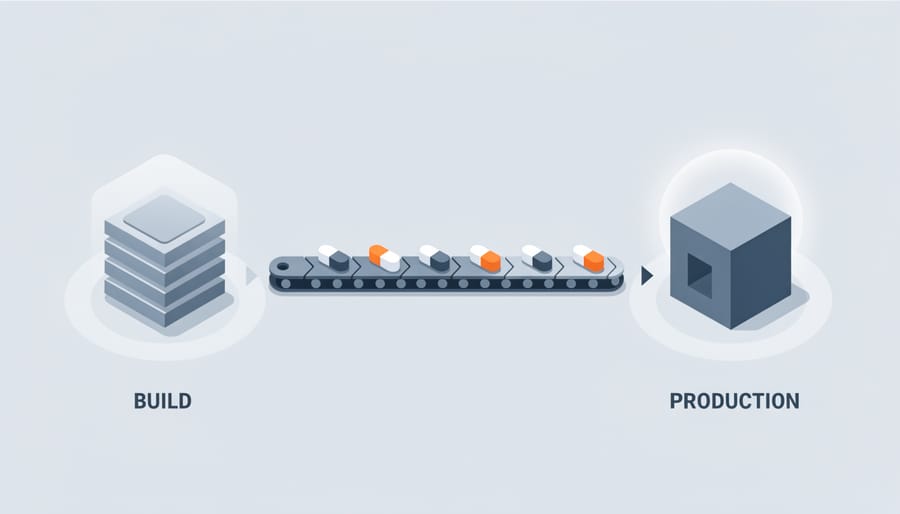
CI/CD pipelines sit at the center of most development operations jobs. A pipeline takes a code change and moves it through automated build, test, and deployment stages, so a release becomes a repeatable process instead of a manual event that depends on one person’s memory. In a job description, this duty usually reads as designing, maintaining, and improving those workflows so teams can ship small changes often with less risk.
Two practices separate a mature pipeline from a fragile one. The first is release gating: automated checks such as unit tests, integration tests, and approval steps that a change must clear before it reaches production. Gates catch defects while they’re still cheap to fix and give auditors a clear record of what was verified and when.
The second is rollback strategy. Even well-tested releases fail sometimes, so the role includes planning for fast recovery, whether through versioned artifacts, blue-green deployments, or feature flags that switch off a faulty change. A rollback that takes minutes rather than hours often decides whether a bad release is a minor incident or a major outage. When you write the posting, name these outcomes instead of listing pipeline tools.
Security Built Into the Delivery Process
Security is part of the delivery process itself, not a gate bolted on at the end. A development operations professional makes the secure path the easy path, and does it alongside the security team rather than in place of it.
Secrets management comes first. API keys, database credentials, and certificates should never live in source code or build scripts. The role sets up a vault or managed secrets service, rotates credentials on a schedule, and makes sure pipelines pull secrets at runtime instead of storing them.
Next is vulnerability scanning. Pipelines should check dependencies, container images, and infrastructure definitions on every change, so a known flaw gets flagged while it’s still cheap to fix. The DevOps engineer wires those scans in and tunes the thresholds. The security team decides which findings block a release and which only warn.
Access controls matter just as much. That means least-privilege permissions for pipelines, service accounts, and people, plus approval steps for production changes and logging of who changed what.
Finally, the role produces compliance evidence as a byproduct of normal work. When every deployment is versioned, approved, and logged, auditors get a clear trail without a scramble before each review.
None of this works as a handoff. Security sets policy and risk tolerance, and development operations builds those controls into everyday delivery.

Skills, Tools, and Qualifications to Look For
Start with a hard line between what a candidate can’t do without and what you’d happily train. Scripting ability and a working grasp of at least one cloud platform belong in the “must-have” column. Familiarity with a specific vendor’s dashboard rarely does, because people pick up tools faster than they pick up habits like automating repetitive work or thinking through failure modes.
Treat every tool name below as an example. Stacks vary widely between organizations, and a strong engineer who has used one orchestrator can usually learn another within weeks.
| Skill area | Example tools or practices | Why it matters to the business |
|---|---|---|
| Scripting and programming | Python, Bash, PowerShell, Go | Replaces manual steps with repeatable automation |
| Cloud platforms | AWS, Azure, Google Cloud, infrastructure as code | Makes environments consistent and quick to rebuild |
| Containers and orchestration | Docker, Kubernetes | Keeps applications portable and scalable |
| Configuration management | Ansible, Terraform, version-controlled configs | Reduces drift and supports auditable processes |
| Observability | Metrics, logs, tracing, alerting | Shortens the time it takes to detect and resolve incidents |
Nice-to-have skills usually include experience with a particular monitoring suite, familiarity with service meshes, or exposure to cost optimization practices. These sharpen a strong candidate, but they shouldn’t disqualify a capable one.
Don’t overlook the human side. This role sits between developers, operations staff, and security teams, so clear written communication matters as much as technical depth. Look for people who can explain a failed deployment without blame, document a runbook someone else can follow, and negotiate priorities across teams. A candidate who automates brilliantly but can’t collaborate will struggle in most enterprise environments.
How the Role Changes by Seniority and Team Setup
Expectations shift noticeably as the role matures. A junior engineer typically works from defined tickets: maintaining pipelines, handling routine deployments, and learning the monitoring stack under guidance. Mid-level engineers own whole services or environments and are expected to diagnose production issues independently. Senior engineers design the delivery architecture itself, weigh trade-offs on reliability and cost, and mentor others. A lead sets standards, shapes the roadmap, and represents the team in conversations with security, compliance, and product stakeholders.
Team setup changes the job just as much. In a platform team, the engineer treats internal developers as customers, building self-service tooling and paved paths that make safe deployment the easy option. In an embedded product team, the same person sits close to the code and tunes pipelines and infrastructure around one application’s needs. In a managed services arrangement, the work centers on documented procedures, service levels, and predictable handoffs, which is where a clear SOP in software delivery becomes essential.
Many enterprises bring in a technology partner when the backlog outpaces hiring, when specialized skills like security automation are scarce, or when round-the-clock coverage isn’t realistic in-house. A partner can fill those gaps while your core staff keeps ownership of architecture and priorities.
Turning Responsibilities Into a Clear Job Description
A strong posting starts with a short summary that says why the role exists. Skip “seeking a rockstar” and write something like: “You’ll help our product teams ship changes safely and keep production stable.” That one sentence tells a candidate more than a paragraph of company boilerplate.
From there, use four blocks: summary, responsibilities, requirements, and preferred skills. Keep the requirements list to what the person truly needs on day one. Everything else goes under preferred.
Write responsibilities as outcomes, not tool names. Compare “Manage Jenkins and Terraform” with “Maintain automated pipelines so approved changes reach production within an agreed window, with a tested rollback path.” The second version tells candidates what success looks like and survives a change in tooling.
Define how success gets measured, too. Client-centric teams usually tie the role to things the business actually feels, such as release frequency, recovery time after incidents, and how easily a change can be audited. Pick two or three measures and state them in the posting. If your team documents its release and incident practices as standard operating procedures, mention that, since candidates will want to know whether they’re joining an organized process or building one from scratch.
Watch for these common mistakes:
– Tool laundry lists. Fifteen named products in the requirements will screen out strong engineers who know eleven of them.
– Unicorn requirements. One person is rarely an expert developer, network engineer, security specialist, and database administrator all at once.
– Vague seniority. If the title says “senior” but the duties read like entry level, you’ll attract the wrong applicants.
– Ignoring security duties. Spell out who owns secrets, scanning, and access reviews.
Common Questions About Development Operations Jobs
Is DevOps a role or a culture?
Both. It began as a culture of shared ownership between developers and operations, but many enterprises now hire dedicated engineers to build and maintain the delivery tooling that makes that culture practical.
Do DevOps engineers need to code?
Yes, at a working level. You don’t need to be a product developer, but scripting, reading application code, and writing automation are everyday tasks.
How does DevOps differ from SRE?
DevOps centres on delivery speed and collaboration across the pipeline. SRE applies software engineering to reliability, usually with defined service-level targets and error budgets, so the two overlap heavily in practice.
Do certifications help?
Cloud platform and Kubernetes certifications can signal baseline knowledge, but they don’t replace hands-on experience with real pipelines and incidents.
Smaller teams often ask whether a dedicated hire is necessary. Not always. If you ship infrequently and your infrastructure is simple, a developer with solid automation habits may cover the need. Once releases slow down, deployments become risky, or on-call work starts eating engineering time, a dedicated role or a managed services partner begins to pay off. Whichever route you take, good process documentation keeps the work repeatable, so releases don’t depend on one person’s memory.
A strong development operations job description does three things well. It ties every duty to an outcome the business cares about, such as faster releases, fewer outages, and changes you can audit. It balances engineering skills like scripting and pipeline design with operational ones like monitoring and incident response. And it treats security as part of the delivery process, so secrets handling, vulnerability scanning, and access controls are written into the role from the start.
Write the posting around results and realistic requirements, and you’ll attract candidates who can do the work rather than recite a tool list. That matters even more in Operations Software Development, where the people in this role build the automation and tooling that keep operations running, not just operate what already exists.
If you’re deciding how to staff the role, whether to add automation to your current stack, or whether managed IT support could fill gaps, the team at ISTS is ready to talk it through.
Leave a Reply