How to Handle and Store Selank Nasal Spray for Laboratory Use
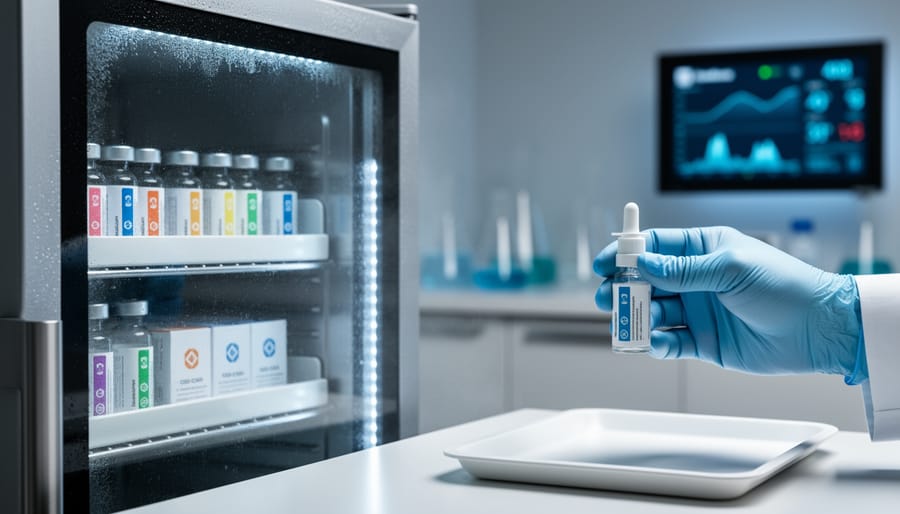
Handling Kylo Selank Nasal spray in a lab comes down to four things: store it exactly as the supplier’s documentation specifies, limit its exposure to temperature swings and light, log every access, and verify the product’s condition before each use. Do that consistently and you protect both the integrity of your samples and the defensibility of your results. Plan on about 15 minutes to set up a repeatable workflow and a few minutes per handling event after that. The main prerequisite is the supplier’s current certificate of analysis and storage guidance in hand, since specific temperatures and shelf life belong to the manufacturer, not to a general article.
Kylo Selank Nasal is a working example of the kind of research-use-only material that demands this discipline. Small vials, tight tolerances, and zero margin for undocumented excursions.
Most failures here aren’t dramatic. A unit sits on a bench for an hour, a freezer door gets propped open, nobody can say who last touched a lot. Those gaps are fixable with the right checklist, safety limits, and monitoring. This guide covers the tools you need, the stop conditions that should halt work, a step-by-step process, and how to verify the result. Everything here is for research use only, not for human or veterinary use.
Tools and Materials to Have Ready Before You Open a Vial
Storage Equipment and Environmental Monitoring
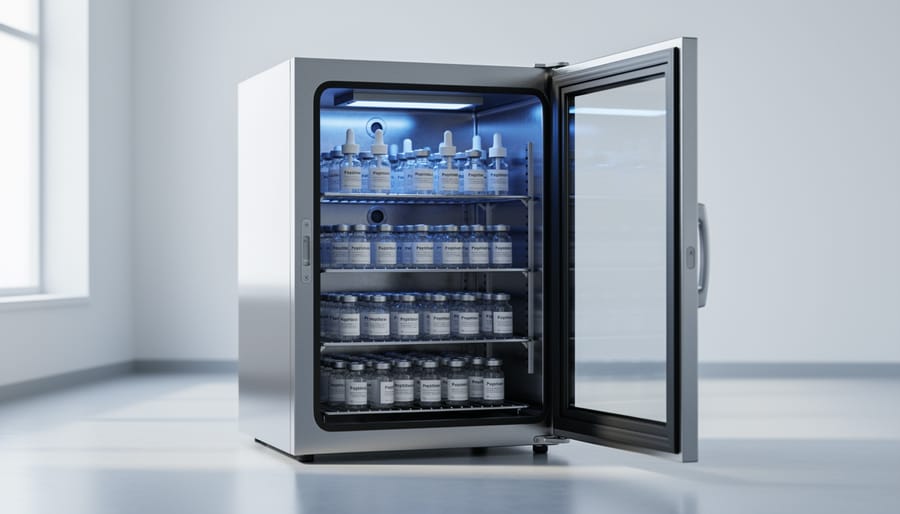
A calibrated, alarmed refrigerator or freezer with continuous temperature logging is the backbone of safe peptide storage. A thermometer you glance at twice a day only tells you what the temperature was at that moment. A logger tells you what happened overnight, over a weekend, or during a compressor hiccup nobody noticed.
If you’ve run infrastructure, the pattern is familiar. You wouldn’t leave a production server without health checks, and you shouldn’t leave a cold unit without the equivalent. Remote temperature monitoring alerts notify the right person the moment a reading drifts outside range, so an excursion becomes a quick fix instead of a lost lot.
Here’s the equipment and materials to have in place:
- A temperature-monitored refrigerator or freezer with an alarm.
- Amber or opaque secondary containers to limit light exposure.
- Nitrile gloves, a lab coat, and eye protection.
- Sterile pipette tips or calibrated dispensing tools.
- Labels and permanent markers.
- The supplier’s certificate of analysis and storage specifications.
- A data logger or temperature probe.
- A handling log, on paper or digital.
Keep research peptides on their own shelf or in a dedicated unit. Don’t store them beside food, reagents that give off volatile vapors, or general-use stock, since shared space invites contamination and accidental access.
Documentation and Labeling Supplies
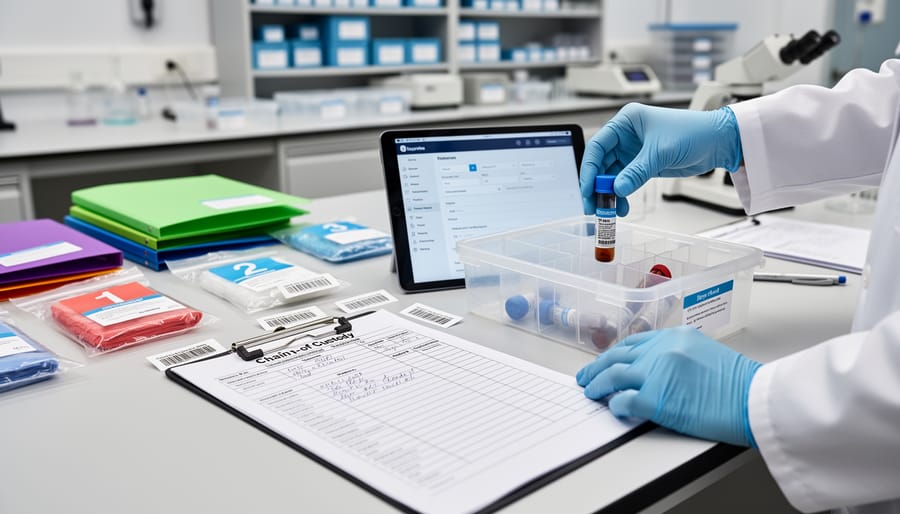
Before the first vial leaves the freezer, prepare the paperwork that will make its history provable. At minimum, each unit needs a record of its lot number, receipt date, date opened, and storage conditions, plus a chain-of-custody sheet that shows who handled it and when. Label every vial and box so these details travel with the material rather than living only in someone’s memory.
Loose paper works until the day an auditor asks for the full history of a single lot. Then you’re hunting through binders, deciphering handwriting, and hoping nothing got misfiled. Structured, access-controlled digital logs solve that. Entries are time-stamped, edits are tracked, and only authorized staff can sign off on a transfer. You can pull a complete record in seconds instead of hours.
If your team already tracks equipment or samples in spreadsheets, that’s a reasonable starting point. From there, handling log automation can capture entries at the point of use, flag missing fields, and keep the audit trail intact without adding steps for the bench scientist.
Safety Warnings and Stop Conditions Before You Proceed
Before you open anything, set the boundaries. Selank nasal spray handled in a lab is research-use-only material, supplied for in-vitro or approved experimental work and not for human or animal administration. Treat that status as a hard compliance line, and follow your institution’s biosafety and chemical hygiene policies for the rest.
Start with personal protection. Wear gloves, a lab coat, and eye protection, and work in a ventilated area so you aren’t breathing in stray mist. Actuating a nasal spray produces fine aerosol, so dispense away from your face, avoid skin contact, and never test-spray a unit to “see how it works.” Keep the material in a restricted location, away from unauthorized personnel and out of shared or public workspaces.
Next, know your stop conditions. Do not proceed if you see any of the following:
– A damaged or leaking device
– A broken or missing seal
– Cloudiness, discoloration, or visible particulate matter
– Missing labels, lot information, or paperwork
– A known or suspected temperature excursion
If any of these apply, don’t try to salvage the unit. Quarantine it in a clearly marked, segregated spot, document exactly what you observed, and contact the supplier or your safety officer for direction. Recording the lot number, the date, and photos of the problem while it’s fresh makes any later review far simpler.
Treat this as an auditable SOP workflow: each decision, from inspection to quarantine to escalation, should leave a written trace that another person can follow. That discipline protects your people and your data, and it makes compliance reviews far less painful.
Step-by-Step Process for Receiving, Storing, and Dispensing Selank Nasal Spray
Receiving and Initial Inspection
Intake is where sample integrity is won or lost, so treat it like a deployment checkpoint. Check the outer packaging, then the device itself: a broken seal, leaking nozzle, or cracked housing means stop. If the shipment included cold-chain indicators or temperature loggers, read them before anything goes in storage. A shipment that arrives warm should be quarantined, not used, until the supplier confirms the excursion’s impact. Photograph problems immediately, because evidence gets harder to establish with every hour that passes.
- Inspect packaging and seals on arrival and photograph any damage.
- Verify the lot number and certificate of analysis against the order.
- Record receipt in the handling log.
- Move the unit promptly to the designated cold, dark storage location.
- Label it with the date received and, later, the date opened.
Logging each step in a digitized chain-of-custody keeps the record timestamped, access-controlled, and ready for audit.
Storage Conditions: Temperature, Light, and Humidity
Peptide formulations are chemically delicate. Heat speeds up hydrolysis and oxidation, light can drive photodegradation, and moisture can promote breakdown or encourage microbial growth. Each factor shortens the useful life of the material, and the damage is usually invisible until results start drifting. That’s why supplier-specified conditions beat improvisation. The certificate of analysis and stability data reflect what the formulation was tested against, and a “close enough” fridge setting isn’t the same thing.
Store the unit at the supplier’s stated temperature, in its original packaging, away from light. Skip the refrigerator door shelf. Every time the door opens, that shelf takes the biggest temperature swing, and repeated cycling stresses the formulation more than a steady, slightly imperfect setting would. Use an interior shelf, ideally near your logged probe so the readings reflect what the sample actually experiences.
Keep the cap on whenever the device isn’t in use, and keep the nozzle from touching surfaces, gloves, or other samples. Humidity matters too: store the device in a dry, closed container rather than in a damp cold room or open tray.
Dispensing and Contamination Control
Dispensing is where most avoidable contamination happens, so treat every opening of the device as a controlled event. Before you start, wash and glove, wipe the work surface with a lab-approved disinfectant, and have your labels and log ready. The goal is simple: touch the device as little as possible, for as short a time as possible.
Limit open-and-close cycles. Plan each session in advance so you dispense what the protocol needs in one sitting rather than returning to the unit several times a day. Each exposure to room air, humidity, and handling is a chance for degradation or microbial ingress. Return the unit to its specified storage condition promptly instead of leaving it on the bench while you work.
Keep the nozzle and cap clean. Never let the tip contact gloves, surfaces, instruments, or samples, and never wipe it with a non-sterile cloth. Recap immediately after use. If the tip touches anything it shouldn’t, record the event and treat the unit as suspect under your SOP.
Prevent cross-contamination. Dedicate one unit to one study arm or sample set, and don’t share devices between operators or experiments. Label each unit with its lot, date opened, and assigned project, so there’s no ambiguity about its history.
Track actuations. Many sprays have a defined number of doses or an in-use stability window, so log every actuation, including priming sprays, against that limit. A simple counter in your digital record, with an alert as you approach the limit, beats relying on memory.
Aliquoting is a special case. Transfer material into smaller containers only where your SOP and the supplier’s guidance explicitly permit it, and document the transfer like any other chain-of-custody step.
Verifying Sample Integrity and Choosing Your Next Steps
Before any Selank nasal spray goes back into use, check it against the baseline you recorded on receipt. Compare clarity, color, any particulate, the condition of the nozzle and seal, and the label. If something looks different from that first entry, treat it as a stop condition, not a judgment call.
Next, pull the temperature log for the full storage period. Look for excursions, however brief, and note their duration and size. Then check the expiry date and the in-use date you wrote down when the device was first opened. Finally, compare your handling record, including how many times it was opened and how long it sat outside cold storage, against the supplier’s stability statement. If your history falls outside what the supplier documents, you can’t assume the material is fine.
Analytical verification is worth considering when the storage history is incomplete, an excursion can’t be ruled out, or the material will support results you’ll have to defend. A third-party purity test gives you evidence that records alone can’t.
Build a simple review cadence so these checks don’t depend on memory. A monthly pass over inventory, logs, and approaching expiry dates is enough for most labs. This is where ISTS fits naturally: a lightweight inventory and monitoring dashboard, automated alerts for temperature deviations or upcoming expiry dates, and an audit trail that shows who handled what and when. Those controls turn a scramble before a compliance review into a report you can pull on demand.
Frequently Asked Questions About Selank Nasal Spray Storage in the Lab
Most storage questions come down to one rule: the supplier’s documentation and your institutional SOPs outrank any general guidance, including this article.
How should an unopened unit be stored?
Keep it sealed, in its original packaging, protected from light and heat, at the temperature the supplier specifies. Record the storage location and conditions on receipt.
Can it be frozen and thawed?
Peptide formulations are generally sensitive to repeated freeze-thaw cycles, so avoid them unless the supplier explicitly says otherwise. When in doubt, ask for stability data before treating a thawed unit as usable.
What should I do after a temperature excursion?
Quarantine the affected units, document the duration and conditions from your temperature log, and contact the supplier. Do not return them to normal stock until a decision is recorded.
How should expired material be disposed of?
Follow your institution’s chemical waste procedures and your safety officer’s guidance, and log the disposal against the lot number.
Opened-unit shelf life and inter-lab transport depend on the formulation, so check the certificate of analysis and your chain-of-custody procedures before acting. A documented answer from the supplier beats an assumption every time.
Reliable Selank nasal spray handling and storage for laboratory use comes down to four habits: prepare before you open a vial, respect your stop conditions, follow each step the same way every time, and keep records you can verify. Align your SOPs with supplier guidance, then consider automating logging and alerting. If you’d like help with monitoring, data capture, or audit-ready tooling, talk with ISTS.
Leave a Reply